Why Write
Reflections on Writing, Books, and Artificial Intelligence

Last week I moved out of the rented room where I spend most of my days writing, reading, and thinking. This involved carrying hundreds of books to my car to be shuttled to a new room, trying to break down (often unsuccessfully) my assembly-required bookshelves, and stumbling across old journals, notes, and Father’s Day cards drawn by my two daughters.
The final furniture to move was my desk and chair. Something about seeing the room stripped to these bare essentials hit me. For as long as I can remember, I wanted to be a writer. I wrote for the literary journal and school newspaper in high school, majored in English in college, and got a Master’s degree in fiction writing (much to the delight of my Republican critics). Most of my adult life, I have supported myself – at least in part – by sitting at a desk and writing words on a computer. In the room I was absenting, I finished a book, wrote articles, stared at the walls (and sometimes, lying on the floor, up at the ceiling), and wrestled with the world outside – all the violence, upheaval, technology, and distortion of truth that has come to mark our times.
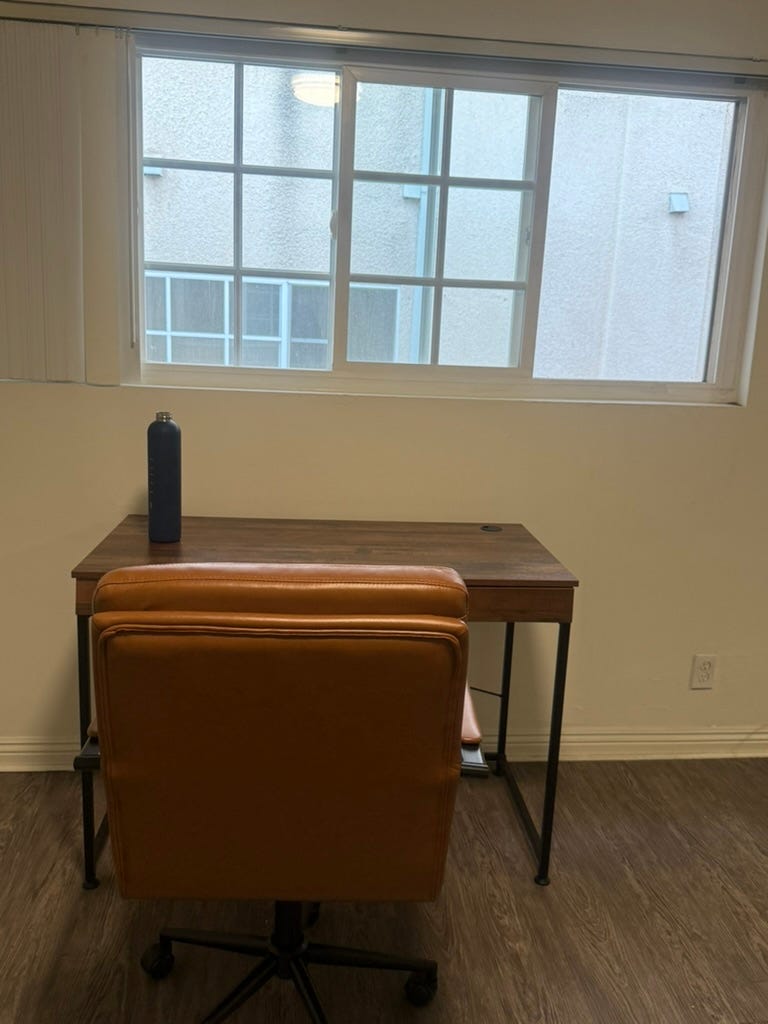
It can be a lonely existence, writing. But it can also connect you to the vast expanse of human experience; all the longing, heartbreak, inquiry, inspiration, mythology, and storytelling that has been captured in language since the scribes of the ancient world started keeping accounts thousands of years ago. It got me thinking: why do people write? And what does the future hold for writers?
Why Write?
Joan Didion once wrote, “I write entirely to find out what I’m thinking.” That has been the case for me. Sure, when I sit down to write, I usually have a sense of where I’m going – an idea, an argument, even an outline. But anything worthwhile that I’ve written has ended up somewhere I didn’t expect – the sentences lead me in the direction of an idea or image that I didn’t have at the outset, a new way of understanding or seeing a piece of the world. In the best of circumstances, that process is akin to revelation, a sense of ephemeral discovery that you can’t quite explain to yourself after it happens.
Since leaving the White House in January of 2017, I’ve written three books as well as essays, reviews and opinion pieces. The work I’m proudest of has struggled to find out not just what I’m thinking but what I’m feeling; to reckon with my own morally ambiguous experience with power and the ways that power itself has become so corrupting in our time. I’m sure plenty of those words are forgettable. But the ones that mattered, at least to me, pulled something out of me that I didn’t know was there: an insight or feeling that looked (imperfectly and incompletely, I’m sure) at power from the outside-in – something that so many of the far greater writers I admire have done far better than me. Orwell. Baldwin. Arendt. Didion. Vonnegut. Le Carre. DeLillo. Zweig. Just to name a few.
Which leads me to reading. I also write because I like to read. In many ways, that’s my origin story as a writer. For as long as I can remember, I liked stories – in particular, stories contained in the object of a book. To this day, nothing makes me want to write more than reading something that is provocative, revelatory, or just finely rendered. Indeed, I often think of a line that one of my favorite professors told me about Don DeLillo’s novel, The Names (one of my favorites). “I reread it every year,” he said, “just for the sentences.”
The sentences. A sentence contains multitudes, changing in meaning depending on how old you are – or what you are experiencing – at the time that you read it. To write is to enter a conversation with the other writers of sentences (living and dead) and the wider world of readers (that’s you). To write is to use this tool that human beings invented – language – so that we can make sense of the feelings inside of us and the things happening around us.
So, yes, writing can help you find out what you’re thinking. More than that, though, writing can help you connect to all the other words that have been written down, the ceaseless effort to find meaning in being human.
The power of books
Which leads me to books. I love being surrounded by the physical presence of books. I can look at a bookshelf and remember how I felt when I first read something. What was happening in my life at that time? Who did I love? What did I fear? How did that book make me feel? What does that author represent to me? What kind of person do I think I am, or do I want to be, as represented by the books I choose to keep on shelves around me.
Sure, I’m often alone in a room. But I’m not. I have all these people with me in the form of their books, the things they wrote to find out what they thought, how they felt, and who they were. When I’m stuck, the language of great writers can usually get me unstuck.
I write this at a time when people are reading fewer books. As an author, I’ve noticed that the portion of books that I sell is increasingly weighted in the direction of audiobooks and e-books. As a consumer, I find myself following this trend, listening to more books as I walk, run and drive. And as a “content creator,” books are a small share of my own output compared to writing for the New York Times, recording Pod Save the World, appearing on MS Now, and posting on social media platforms. But scrolling is not reading as sure as posting is not literature.
Three weeks from now, my next book, All We Say: The Battle for American Identity will go on sale (pre-order now!). Like other authors, the thought fills me with trepidation. In part because you worry about whether people will buy the book and whether people will like it (which determines, to some extent, whether you can write another one). And you know, especially these days, that some people will say mean things about what you write (sometimes without even reading it). It’s a very vulnerable experience, no matter how thick you pretend your skin to be, and I’ve done a lot of pretending over the years. It’s rough out there, particularly for people writing and talking about things like politics and foreign policy.
More than that, it’s a strange experience to spend years writing something alone in a room and then to go out and talk about it. Because nothing you say in an interview could possibly be as carefully considered and constructed as the words you wrote in the actual book. Yet you know that far more people will hear you talk about your book than read it.
Which leads me back to physical books, the company I often keep. I am one of those people who is spiritual without feeling a deep affinity for a particular religion, though I believe in God, admire aspects of many faiths, and was raised from a lineage of two (Christianity and Judaism). God, I believe, is in the mystery around us; books draw us nearer to that mystery.
When I hold a book, open it and read the words inside, I feel something akin to ritual. Here is a tradition that began with the carving of symbols onto stones; of writing down oral epics and copying manuscripts in monasteries; of binding paper together and the replication afforded by the printing press; of human beings trying to tell other human beings something that they believed to be important about life within this universe and preserving it for posterity. Here is a physical object that is – unlike a social media post, an audio recording, or words stored in a data center or “cloud” – both tangible and lasting. In that way, a book offers connection to both the past and the future.
Writing at the dawn of Artificial Intelligence
Which brings me to the last part of this reflection: the onset of artificial intelligence (AI). Like every writer I know, I have been fascinated, terrified, and confused by the introduction of large language models (LLMs) like Chat GPT and Claude.
The room I recently moved out of is where I first explored these LLMs at length. I found myself simultaneously riveted and disoriented conversing with a limitless expanse of data packaged and programmed into something that resembles consciousness, a kind of being with opinions that seem purposely shaded in the direction of my own. How strange it was to think that this LLM had been trained on so much more data – including millions of books – than I could ever read or review. How harrowing it was to realize that it was a product of the very unbridled capitalism that has concentrated so much power in the hands of so few people – most of whom have become full stakeholders in the destruction of our democratic polity, and some of whom seem to think of themselves as godlike in their appetites and aspirations. How frightening it has been to confront a version of automation that seems poised – maybe designed – to replace my vocation.
It is hard not to foresee a very-near future in which these LLMs are churning out news reports, analysis, screenplays, and books on myriad subjects, Indeed, this is already happening. It is increasingly difficult to know for certain whether writers are the authors of their own work or whether they’ve become collaborators with technology trained on the work of other writers. Will what we call writers become experts in writing prompts more than writing stories? After all, staring at the wall (or ceiling) can seem counter-productive compared to sharing your outline or idea with an LLM that contains so much knowledge and is programmed to be eager to please – whether it be you or a wider audience.
At times, I have experimented by asking an LLM to react to an idea, respond to something I’ve written, or provide research to buttress an argument. But something always stops me when it inevitably asks if I’d like help drafting something.
What, then, is the purpose of writing? How can I write to find out what I’m thinking if AI is doing the thinking for me? How can I write to interrogate what I’m feeling if the thing that is doing the writing is incapable of feeling as I do? How can I find that connection to human experience in books if humans have been removed from the act of their creation?
Behind every piece of writing is the unseen experience of a human being. Orwell’s failing health and revulsion at totalitarianism while writing 1984. Tolkien’s experience of World War I which must have haunted his creation of The Lord of the Rings. Arendt’s history not just of political and philosophical inquiry but also of injustice, anti-Semitism, exile, and incredulity that feels tightly woven into The Origins of Totalitarianism. Baldwin’s visceral revolution against the dehumanization of racism in his essays. Vonnegut’s absurd survival of the firebombing of Dresden which allowed him to write such a humane and darkly funny anti-war novel as Slaughterhouse Five. So it goes. Creations that do so much more than recreate language in response to being trained on vast sets of data. The alchemy that can only happen when a human being sits in a chair and tries to write something, to tell other human beings something about what they think or how they feel.
When writers retreat into a room, they bring with them their broken hearts, capacity for love, unpredictable moods, memories of travel, and shifting beliefs, doubts, and certitudes. They also bring their mundane hunger, worries about money, fatigue, euphoria, and at times a dose of alcohol, caffeine or drugs. Perhaps they are struck by the way the light shines through a window, the sound of birds outside, or the voices drifting in from the street. Above all, there is a stillness and quietude that cuts against our current mania for screens and competition for attention, the veneration of so-called entrepreneurs profiting off the collapse of what we might call civilization.
The next room
I have no idea what the future holds for writers. Nor do I want to become a luddite, a man moving further into middle age lamenting invention and innovation, afraid of the future. AI will certainly play some role in the creation of language that informs, entertains, and holds the attention of human beings.
However, I take even greater comfort in the connectivity I have with books. Somehow, through thousands of years, amidst the rise and fall of empires, the beginning and end of wars, and the emergence of seemingly transformative technologies, there have been writers. It’s what unites the man in ancient Egypt who chiseled lessons onto stone with anyone who tries to write a story today.
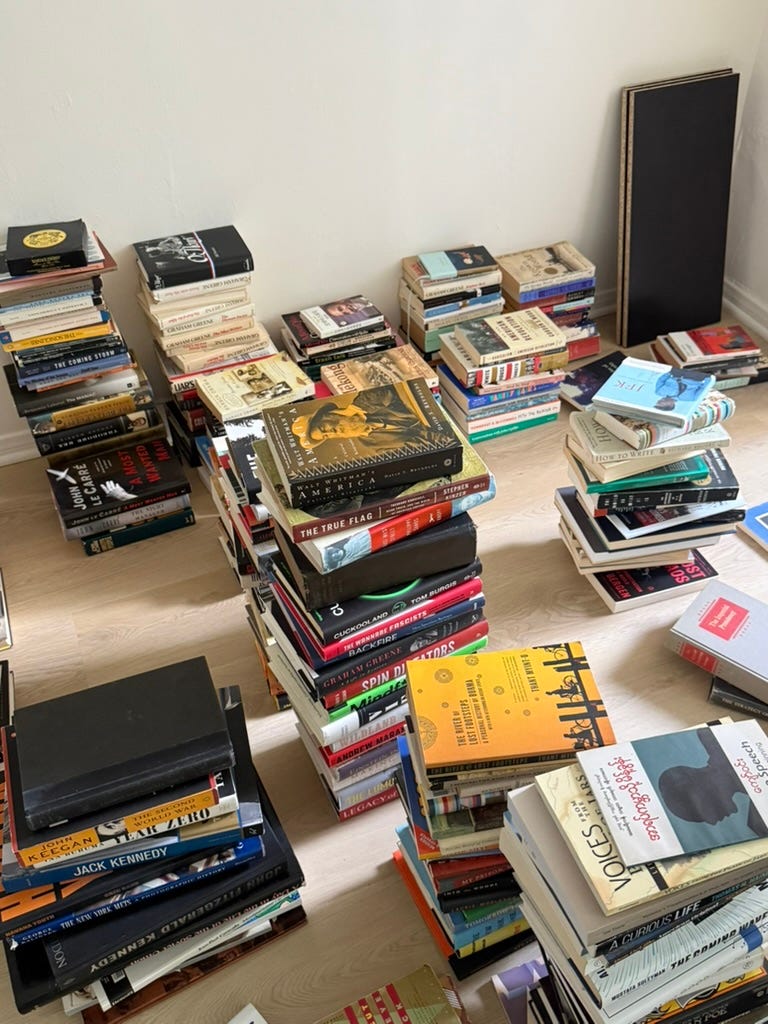
I have moved into a new room to write. The books are stacked and ready to be shelved. The light, I notice, is different: brighter, with different shadows cast. The air is a bit cooler, closer to the ocean. Sea birds make different sounds than the crows. And while I am outside that room, new things will happen to me and to the world.
I’ll sit in a chair at a desk and think and consider the power of a blank page. I’ll read new books and reread old ones or simply run my hand along their spines when the world – online or offline – becomes oppressive. I’ll try to summon words and shape them into sentences. I’ll try to feel that connection to the deep, unseen currents of words that are all around us until something like faith leads me to arrange them into sentences. I will fail, and then I will try again.
I always enjoy reading and listening to your political analysis, but this was something else. Beautiful words and thoughts. Thank you.
My first memory - a book. The last present to be opened, knowing that it will be the best - a book. The first things that I look at when going into someone's home - their books.
Your words remind me of when I was a boy and read and read and read and saved all of my books. I’ve loved books since I could read, loved to sniff the inside pages of a new book. It was like sniffing the inside of a new car: wholesome. Keep reading and writing, Mr. Rhodes. Thank you.